

The Runes
Runes are a form of written characters, just like letters.
The characters are used to represent the sounds of words in writing. The runes were used to write the language spoken in the Nordic countries long ago.
There have been three different rune rows in Sweden: the Proto-Norse rune row, the Viking Age rune row and the medieval rune row..
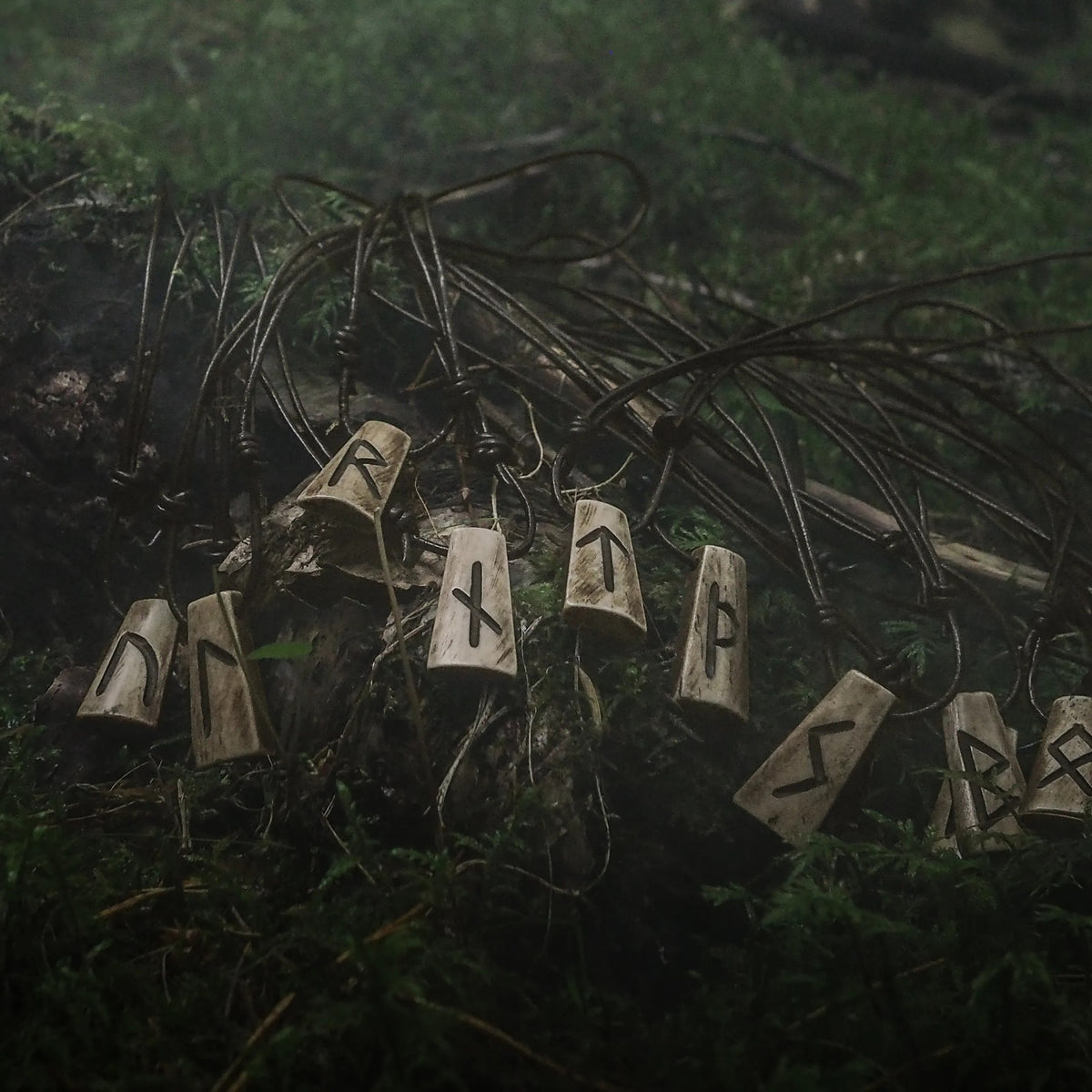
Runes are written characters that were usually carved into wood or bone with a sharp tool, such as a knife.
Runes were almost never written with ink on parchment or paper, but there are a few medieval manuscripts in which runes were used instead of ordinary letters.
The rune row is often called the Futhark after the first six runes fuþark.
Have there been several different rune rows?
The runes were used for more than a thousand years, and the rune row changed several times.
To put it simply, one can say that there have been three different rune rows.
The oldest is called the Proto-Norse rune row.
The second, which was used in the Viking Age, is called the Viking Age rune row. The last one was used during the Middle Ages and is therefore called the medieval rune row. You can read more about the different rune rows below.
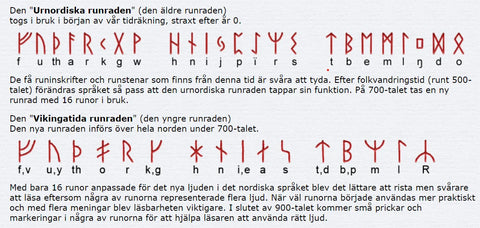
The Proto-Norse rune row
The runes used from around the year 0 into the 8th century are called Proto-Norse runes. They are called this because the language spoken at that time in Sweden and the other Nordic countries is usually called Proto-Norse. Sometimes they are also called the older runes. There were 24 characters in the Proto-Norse rune row. Below you can see what those runes looked like. The letters on the line below the runes show which letter would have been used to write the same sound. The rune for þ (th) was used for a lisping sound, as in the English words thing and that. The rune for ŋ (or ng) was used for the ng sound.
The older (Proto-Norse) rune row has 24 characters.
Most inscriptions old enough to be carved with the Proto-Norse rune row are found on weapons and jewelry. We only have about twenty stones in Sweden with carvings in such runes.
The runes change
During the Viking Age, people no longer used quite the same runes as before. At the beginning of the 8th century the runes were changed. Some of the runic characters kept their appearance. Some were removed altogether, some were given a new look, and some completely new ones were created. The reason the runes were changed was that the spoken language had changed during the 700 years that people had been writing with runes. Some sounds had disappeared and some new ones had been added since the Proto-Norse rune row was created. Among the new sounds were, among others, y, ä and ö.
The Viking Age rune row, 16 characters.

The Viking Age is the name of the period that lasted from around the year 800 to the beginning of the 12th century. However, what we usually call the Viking Age rune row was created as early as the beginning of the 8th century. Unlike the earlier rune row, this one consisted of only 16 characters. It is with these runes that most runestones in Sweden are carved.
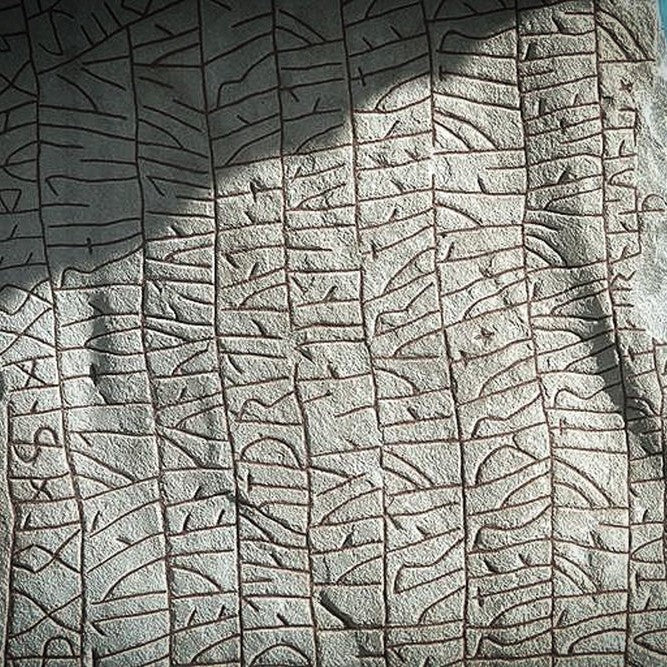
The fourth rune is sometimes transliterated as an a with a small tail (ą). It means that the rune should be pronounced as a nasal a. Nasal means a sound pronounced through the nose. The rune is pronounced this way only on the oldest Viking Age runestones, such as the Rök stone. On younger runestones this rune stands for o.
You may find it strange that there are two different r, one written r and used for the fifth rune, and one written ʀ and used for the last rune in the rune row. The latter stood for a special “buzzing” r sound, which we no longer have in Swedish and which could almost only occur at the end of words. Over time the two r sounds came to merge, and the ʀ-rune was then given a new use, namely as the character for y. The latter can be seen in medieval runic inscriptions (see below).
If you look at the ordinary letters below the runic characters, you will see that many letters we use today are missing. This is because several of the runes were used to represent more than one sound.
Below you can see which sounds these could be. Some runes, such as the u-rune, could be used for a whole range of sounds, while others stood for only one or a couple of sounds. We have a little of this in our alphabet today as well, for example with the letter g which can stand for several different sounds. In that case, however, it is because we have changed the pronunciation of certain words.
The younger rune row with sound values:

There was also a special rule that so-called nasals – m and n – could be omitted before certain consonants in writing. The rune m could, for example, be omitted before p and b, and you can sometimes see that the word kumbl ‘memorial’ is spelled kubl on the runestones. In the same way, the n-rune could be omitted before t, d, k and g. That is why you can sometimes see at for the word and ‘spirit’.
The medieval runes
When the Viking Age was over and people stopped raising runestones, they still continued to carve runes in Sweden. But by then there were also many who could write with ordinary letters. Many priests and others who belonged to the church wrote with letters, but most ordinary people only knew runes. Yet many of those who could write with letters used runes too. They probably found it inconvenient that there were not enough runic characters to spell in the same way as when writing with letters. Already during the Viking Age, people had discovered that the runic characters could be modified with the help of small dots (so-called stings). If you put a dot on the rune i you got a character for e.
Examples of dotted runes (Middle Ages):

This continued until, in the end, people had access to as many runes as there were letters in the Latin alphabet at the time. The shape of the runes could vary quite a lot:
The medieval runes arranged in ABC order. For many of the characters there were different variants, and even more character forms are known:

Source: The Swedish National Heritage Board and rune carver Kalle’s rune school.
https://www.runristare.se/runstensskolan/runorna.html?fbclid=IwAR2hN8UrazpH-9Q4XSSJvtgEVtH7eCXV9aja-6coWjBeEsE0vY8wApLlitY
Köp produkten
Köp produkten
Köp produkten